AI and the Architectural Visualiser: What's Actually at Risk.
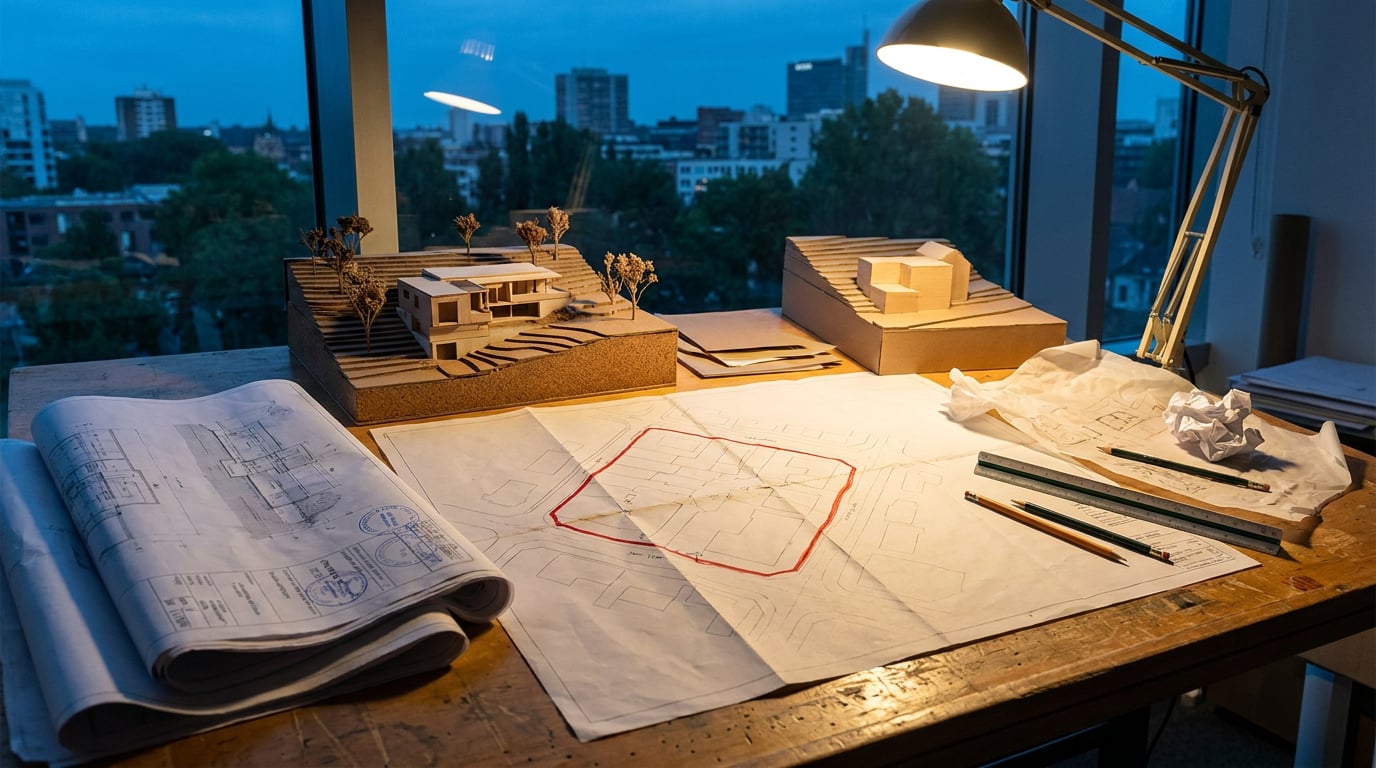
AI isn't replacing visualisers, it's stripping out the grind: base renders, endless revisions, time-of-day variants. Here's what's left, and why it matters more.
The job was never just "making pretty renders"
Ask a Part I student what an architectural visualiser does and they'll describe the glamorous bit: the dusk shot with the warm interior glow, the hero image that lands on a magazine cover or a competition board. Ask someone who has spent three years freelancing for small practices under deadline pressure and you get a different answer entirely.
A visualiser's week is mostly camera angle decisions, client feedback loops, and revision cycles. Someone picks the viewpoint that shows the extension without exposing the neighbour's overlooked garden. Someone decides whether the planning officer needs to see the roofline against the streetscape, or whether that view actually undersells the scheme. Someone sits through a call where the client says "can we just see it a bit warmer" for the fourth time this month. The base render, the actual moment of hitting generate and waiting, has always been the smallest part of the job in terms of judgement, even when it ate the most hours.
That gap between hours spent and judgement exercised is exactly where the conversation about AI gets confused. If you think the job is the render, you're right to be nervous. If you think the job is everything around the render, the picture looks very different.
The render was never the hard part. It was the part that took the longest, which is not the same thing.

What AI is genuinely good at removing from the workload
The honest answer is: the mechanical repetition. Not the thinking, the repetition.
Generating a full set of camera angles for a scheme used to mean manually setting up each view, framing it, rendering it, waiting, then doing the next one. A visualiser using Shoot in ArchAdemia Tools can generate that full set of exterior and interior camera options in one pass, with exterior and interior handled separately as their own runs. That's not a stylistic choice, it's the difference between an afternoon of setup and a single generation pass while you go and do something that actually needs your attention.
The "can we see it at dusk" request used to mean a lighting rebuild and a re-render, every single time a client asked. Retouch's one-click re-light presets, Golden hour, Dusk, Blue hour, Night, Overcast, Sunny, regenerate the whole document at a different time of day or weather as a new layer, without touching the underlying scene setup. The late-stage material change ("can we see it in brick instead of render") used to mean redoing the shot. Material swap in Retouch replaces the texture in a selected area to match a reference, as its own toggleable layer, without touching the base geometry.
Then there's the wide render that's gone soft in one corner, or has a repetitive tiling pattern nobody noticed until the third review. The old fix was re-running the whole image and hoping the rest held together. Enhance area re-renders just that selected region at higher resolution and composites it back in through the selection. No prompt needed, no risk to the rest of the frame.
The common thread across all four: none of this was ever about taste. It was about hours. A visualiser who spent a Tuesday rebuilding lighting for a dusk request wasn't exercising judgement, they were operating a machine that happened to require a human at the controls. Reporting from Chaos and Architizer's industry survey found 43% of respondents see AI's greatest impact in concept and pre-design work, not in the interpretive decisions that come later. That tracks with what these tools are actually doing: removing the grind, not replacing the read.
AI is compressing render-production hours. It is not replacing the visual judgement that decides what those renders need to say.
What AI still cannot do: the part that was always the actual skill
Here's the distinction that matters, and it's the one that gets lost whenever this topic turns into a panic. A camera angle that sells a scheme to a planning officer is not the same camera angle that sells it to a client with money to spend. The planning officer wants to see how the massing sits against the neighbours, how daylight reaches a habitable room, how the extension meets the street. The client wants to feel something about the finished kitchen. Knowing which is which, and knowing that a single beautiful render can be the wrong image for a Design and Access Statement, is not a technical skill. No model chooses that for you.
Reading a brief and knowing what an image needs to communicate is still entirely a human act. Composer's manual posing and gizmo work still requires someone deciding where the eye goes in a scene and why: whether the camera sits at eye height to feel like a person standing on the pavement, or drops low to exaggerate the presence of a new frontage. That decision has nothing to do with rendering technology and everything to do with what the image is trying to argue.
Corb on Canvas illustrates the boundary clearly. It can spawn a set of variations along one axis, camera, lighting, weather, entourage or grade, off an image the visualiser has already made and shown it. What it never does is propose a scheme. It reads what's handed to it. It doesn't invent the geometry, the massing, or the openings; those stay fixed by design, composed into every prompt in the set specifically so the model can't wander off and change what the building actually is. That's a deliberate constraint, and it points at exactly where the line sits: variation on an existing decision, not authorship of a new one.
Compare this to other visual disciplines making the same distinction. A product photographer doesn't just pick the sharpest image of a kettle, they pick the one that explains how the handle sits in a hand. An exhibition designer sequencing views around a gallery isn't choosing pretty angles, they're choosing the order a visitor's body will move through. A landscape designer showing seasonal performance across a planting scheme is making an argument about time, not just producing a nice picture of foliage. None of that judgement is mechanical, and none of it gets automated by a faster render pipeline.
A model can generate four versions of a camera angle in four seconds. It still cannot tell you which one belongs in a planning application and which one belongs in a sales brochure.

Where the economics actually shift for visualisers and small practices
This is where the conversation gets uncomfortable, and it should. Fewer billable hours spent on repetitive render production means one of two things happens to a practice's fee structure: either the price per image drops, or the number of images delivered for the same fee rises. Practices that don't consciously choose one of these end up drifting into the first by accident, which is the worse outcome.
There's a genuine upside here for the small operator. A sole visualiser or a two-person studio can now credibly compete on turnaround speed against a larger outfit with more staff, because the grind hours have shrunk for everyone roughly equally. The advantage that used to belong to whoever had more junior staff to burn on repetitive setup work is eroding. What's left standing is whoever has the better eye.
Credit-based tools change the underlying cost structure too, and this needs building into fee proposals rather than ignored. ArchAdemia Tools' Starter plan runs £29/month for 3,000 credits, which reframes generation cost as per-output spend rather than day-rate labour. That's a genuinely different way to think about pricing a job. A practice that used to quote a day rate for "renders" now needs to separate three things in a proposal: generation capacity (how many variants and angles get produced), selection time (someone's judgement picking the right ones), and revision rounds (how many passes the client gets before extra cost kicks in). Bundling all three into one "render fee" the way practices did five years ago undersells the judgement and oversells the mechanical part.
| What's being priced | Old assumption | What it should reflect now |
|---|---|---|
| Camera angle set | Hours to set up and render each view | Generation credits, near-instant, priced low |
| Time-of-day variants | A re-render per request | A preset swap, priced as a small add-on, not a new render |
| Selecting the final images | Bundled invisibly into "the render fee" | Billed explicitly as judgement time |
| Client revision rounds | Capped low because each round was expensive | More rounds possible; this is where the value now sits |
The risk sitting underneath all of this is client expectation. Some clients will hear "AI does renders now" and assume planning-grade visual work should cost hobbyist money. That's a real threat, but it's a positioning problem, not a technology problem. The visualisers who get squeezed by it are the ones who never separated their fee from their hours in the first place, and now have no other way to explain their value.
What this means for how visualisers should actually spend their time now
Stop competing purely on render polish. Everyone's polish is rising at the same rate because everyone has access to the same underlying model quality, so it stops being a differentiator the moment it becomes the baseline. The competitive edge moves to brief interpretation and narrative sequencing, the ability to look at a scheme and know which three or four images, shown in which order, actually make the argument the client needs made.
Put the time saved on mechanical re-renders back into revision rounds on the images that matter. If a dusk relight used to cost an afternoon and now costs a preset click, that afternoon doesn't have to disappear into extra profit margin, though it can. It can also go into a fourth or fifth pass with the client on the two hero shots that are actually going in front of the planning committee, refining massing emphasis or adjusting exactly how much of the neighbouring context sits in frame.
A workable studio workflow looks like this: use Shoot to generate the full angle set fast across a scheme, exteriors and interiors both, then apply human judgement to select which three or four go forward. Those selected shots move into Layout for the Design and Access Statement or the client deck, where they sit alongside the written narrative rather than as a loose folder of images with no argument holding them together. The mechanical generation happens once, fast. The judgement happens on the shortlist, where it belongs.
One caution worth stating plainly: treat AI re-lighting and material swap as client-facing speed, not as permission to stop understanding lighting and material yourself. A visualiser who doesn't know why golden hour reads warmer through glazing than through render, or why a brick swap needs to respect the mortar joint pattern to look credible, will pick the wrong preset and not notice. The skill underneath the shortcut still has to be real, or the shortcut just produces confident-looking mistakes faster.
The tools compress the mechanical work. They do not compress the need to know what good lighting or an honest material read actually looks like.
The honest verdict
AI is not coming for architectural visualisers as a profession. It's coming for the parts of the job nobody particularly enjoyed doing anyway: the fourth re-render because the client wanted to see it at a different time of day, the manual camera setup repeated eight times for eight angles, the local patch fix that used to mean redoing a whole frame.
RIBA-cited figures put architectural AI use rising from 59% in 2025 to 74% in the most recent survey, which tells you adoption is accelerating fast. It doesn't tell you jobs are disappearing at the same rate, and no reliable source currently measures that. What the evidence does support is a shift in task composition: less time on mechanical output, more time available for interpretation, if the visualiser chooses to use it that way.
The visualisers who struggle will be the ones whose entire value proposition was rendering speed and technical setup, because that's exactly the layer getting commoditised. The visualisers who thrive will treat these tools as compressing the boring bulk of the job so the smaller, harder part, the part that decides what an image needs to say and to whom, gets more attention per project rather than less.
The job is shrinking in hours and growing in judgement density. Said like that it sounds like a loss. It isn't. It's a better trade than it sounds, provided you were actually good at the judgement part all along.
Keep reading.


Try ArchAdemia Tools for yourself
Draw it, model it, render it, publish it. One place, built for architects and small practices. Plans from £29 a month, all in.