Why Practices Still Outsource Visualisation They Could Do In-House.
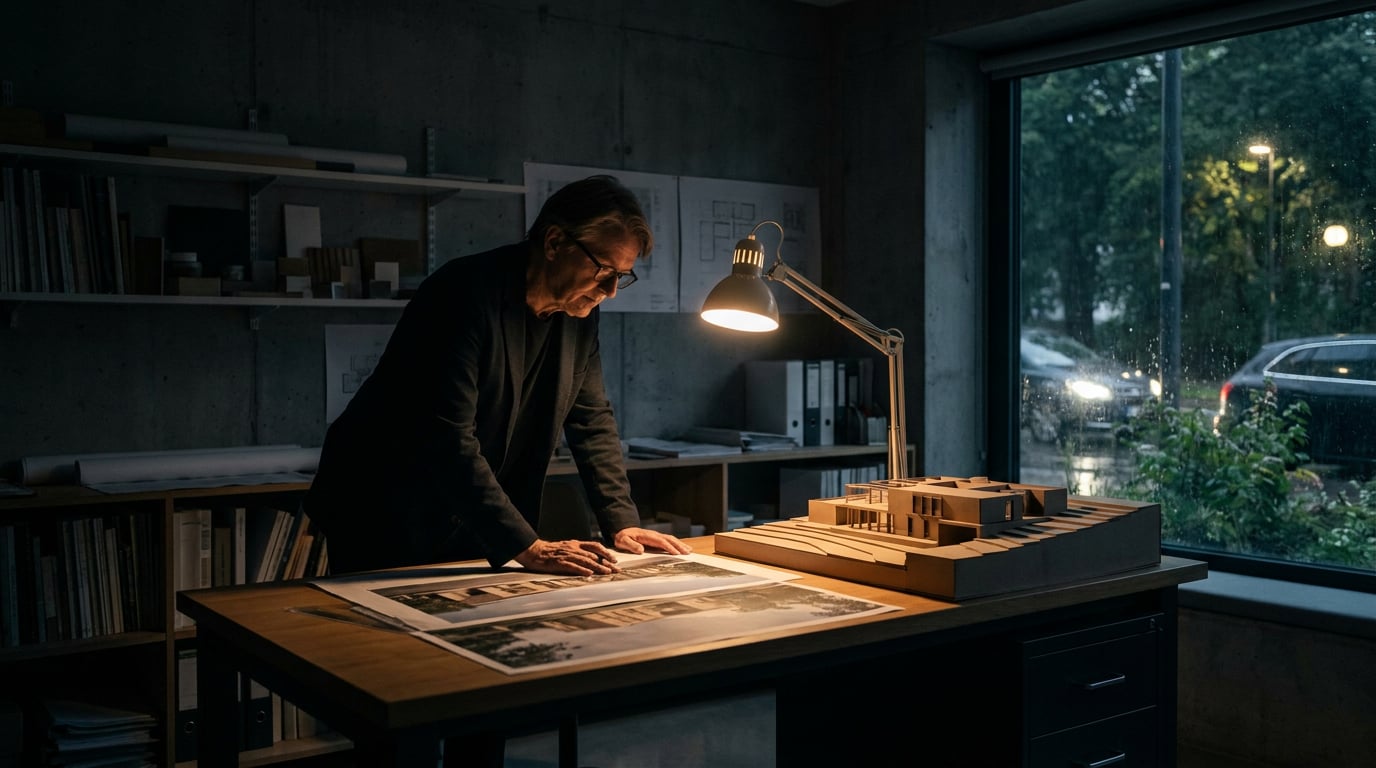
Most practices outsource renders not because they can't produce them, but because the in-house workflow was never built to make it worth trying.
The real reason isn't skill, it's time
Most architects can produce a competent render. Anyone who has sat through a Part II crit knows this. The issue was never whether a director or an associate could learn a rendering workflow, it's whether that workflow fits into a live fee budget alongside drawing packages, consultant coordination and the client meeting at 3pm. Time is the scarce resource in a small practice, not capability.
Outsourcing solves a real problem, but not the one people usually name. It converts an unpredictable internal time cost into a fixed external invoice. A director can price two hours of a visualiser's time with confidence. They can't price "however long it takes me to get this render right," because that number depends on mood, familiarity with the software, and how many rounds of revision the client asks for. Uncertainty is expensive to carry, so it gets pushed outside the practice and turned into a line item.
That's why a director will happily spend two hours briefing an external studio but won't spend two hours in SketchUp or Linea producing the same image themselves, even when the second option is now often faster. Briefing feels like management. Modelling feels like risk. The maths rarely gets examined honestly.
The actual bottleneck isn't the render itself. It's the back-and-forth: a camera angle the client wants to see from ten metres further back, a material swap because the planning officer raised a query about render colour, a lighting change to show the scheme at dusk instead of midday. Under the old model, every one of those small changes meant re-briefing an external studio, waiting for a turnaround slot, and paying for another round. That friction, not the original render, is what makes visualisation feel expensive and slow.
The invoice for a render is predictable. The invoice for the fifth revision of that render is not, and that's the cost practices are actually trying to avoid.
The tools changed faster than the habit did

Most outsourcing relationships in architecture practices were built five or ten years ago, when in-house visualisation meant a slow render engine, a workstation that struggled with GPU load, and weeks of learning curve to get lighting and materials looking believable. Handing that off to a specialist studio made complete sense. The gap in quality and speed between an architect's own effort and a dedicated visualiser's output was wide and obvious.
That gap has narrowed for a specific category of work. Generating a scheme in Linea and sending a perspective view straight into a rendering studio is a materially different workflow to the old model-then-render pipeline that justified handing everything off. When drawing, modelling and rendering sit closer together, in the same session rather than passed between a practice and an external contact, the argument for outsourcing every image starts to weaken.
Shoot illustrates the point clearly: it generates a full set of exterior and interior camera angles for a scheme, exactly the kind of deliverable a practice used to commission externally as a matter of course. A complete set of stills, produced in-house from a model the practice already built, is now a realistic outcome for a Tuesday afternoon rather than a two-week external turnaround.
Habit and procurement inertia outlast the technical justification. Many practices are still outsourcing a problem the tools have already solved, not because the tools are inadequate, but because nobody has revisited the workflow since the outsourcing relationship was set up. The visualiser's number is in the contacts list, the invoice template exists, the process is known. None of that is evidence the process is still the best one.
The workflow that justified outsourcing, slow modelling followed by a separate, specialist render pass, has changed. The habit of outsourcing has not caught up with it.
What outsourcing actually costs beyond the invoice
The invoice is the visible cost. The hidden costs are what make outsourcing worse value than it first appears for repeat, lower-stakes work.
External visualisation adds lag between a design decision and the image that tests it. During concept and planning stages, that lag matters more than most fee proposals admit. A scheme evolves through iteration: try the massing at one storey height, then another; test a brick facade against a render, then a stone one; check whether the roofline reads well from the street. Every one of those tests, done externally, means a request, a wait, and a delivery, rather than an answer in the same working session.
Consider a planning committee query, or a client note scribbled on a printed drawing. Something like "can we see this with the render darker, more like dusk" is a ten-minute task if the practice can generate it themselves. Outsourced, it's another round trip and another line on the invoice, even when the change is genuinely minor. The studio isn't overcharging, the structure of the relationship simply doesn't have a cheap gear for small changes.
Design control leaks out with the brief. An external visualiser makes material choices, lighting decisions and framing calls that the architect would make differently if they were sitting at the keyboard themselves. That's not a criticism of visualisers, who are working from a written brief and their own judgement, not the architect's. But it means the finished image is one step removed from the design intent, and correcting that drift costs another revision cycle.
Small practices lose margin twice over on this. They pay the invoice for the render, and they still spend internal hours writing the brief, checking the output against the design, and coordinating the changes the render was meant to save them from doing. The visualisation gets outsourced; the coordination burden doesn't.
Outsourcing doesn't remove internal time, it relocates a smaller amount of it into briefing and approval, while adding external lag on top.
Where in-house visualisation genuinely struggles

None of this is an argument that outsourcing is obsolete. Some work still belongs with a specialist, and pretending otherwise wastes more time than it saves.
Complex material studies and photoreal finish work still take real skill and real time. A hero image with convincing weathered stone, correct reflectivity on glazing, and a lighting scheme that reads as genuinely cinematic is not a shortcut a director picks up in an afternoon if they've never built that muscle. Some things are worth paying a specialist for precisely because getting them wrong is worse than not attempting them.
Deadline pressure changes the calculation too. A team racing to finish a Design and Access Statement or a competition board the night before submission does not want to be learning a new rendering workflow mid-project. That's the wrong moment to experiment. In-house tooling should be adopted when there's slack in the schedule to build the habit, not during the worst week of the programme.
One-off, high-stakes images still benefit from a second pair of eyes and dedicated time a busy practice genuinely can't find internally. A hero shot for a competition entry, where the image itself is doing a large share of the persuasive work, is a reasonable candidate for external input even for a practice that's otherwise confident with its own tools.
Where in-house tooling earns its place is the middle ground: re-lighting and re-grading a set of stills after client feedback. Once a member has actually learned the workflow, one-click re-light presets, such as Golden hour, Dusk, Blue hour, Night, Overcast and Sunny, answer "can we see it at a different time of day" in minutes, without a re-brief to anyone external. The skill barrier here is low. The time saved is real. But it only pays off if someone in the practice has sat down and actually learned it, rather than assuming it'll be intuitive under deadline pressure.
| Task type | Better suited to | Why |
|---|---|---|
| Planning context views | In-house | Repeats across projects, low stakes per image, needs fast iteration |
| Interior mood shots for client decks | In-house | Standardisable, frequent, benefits from a consistent look practice to practice |
| Re-lighting after client feedback | In-house | Fast turnaround needed, low skill barrier once workflow is learned |
| Competition hero image | Outsourced or specialist-led | High stakes, benefits from dedicated time and a second creative perspective |
| Complex material and finish studies | Outsourced or specialist-led | Genuine skill gap, low frequency of need doesn't justify building the muscle |
What it takes to actually bring it in-house

Bringing visualisation in-house doesn't mean cancelling every external relationship. It means being deliberate about which deliverables deserve a standardised internal process and which don't.
Start with the deliverables that repeat. Planning application context views and interior mood shots for a client deck are strong candidates precisely because a practice produces dozens of them a year, in similar formats, for similar audiences. A one-off competition hero image is the wrong place to start; it's rare, high-stakes, and doesn't build a repeatable process.
Build the plan-to-render pipeline once, then reuse it. Model or import into Linea, send the perspective straight into rendering through Shoot, and standardise a small set of camera angles the practice returns to project after project: the street-level approach shot, the garden or courtyard view, the key interior. Once that pipeline exists, each new project is a variation on a known process rather than a fresh decision every time.
Use the one-click re-light presets, Golden hour, Dusk, Blue hour, Night, Overcast, Sunny, to answer "can we see it at dusk" in minutes rather than sending the request back to an external studio and waiting. This is the single clearest case where in-house tooling beats the old model on speed alone, with no quality trade-off worth mentioning.
Keep the external relationship for what it's actually good for. Hero images, awards submissions, and the weeks where the practice genuinely doesn't have the internal time, that's still a legitimate reason to commission specialist work. The goal isn't zero outsourcing. It's outsourcing by design rather than by default.
Treat credits and plan tiers as a fixed monthly line rather than a per-image invoice. That reframing changes practice-level budgeting. Instead of pricing visualisation project by project and negotiating each commission, a practice on a plan such as Starter, Pro or Max is working against a monthly credit allowance it can spread across an entire pipeline of live projects, from early massing studies through to planning submission stills. That's a different kind of financial planning to a stack of separate visualisation invoices, and it tends to reward practices that use the capacity regularly rather than saving it for one big push.
Fixed monthly capacity changes the incentive: instead of rationing renders to control cost, a practice can iterate freely within the credits it already has.
None of this requires abandoning specialist relationships or pretending a busy studio has spare capacity to learn everything at once. It requires an honest look at which deliverables repeat often enough to justify building a habit around them, and which are rare and high-stakes enough that a specialist's time is still the better spend. Corb, ArchAdemia Tools' assistant, can help scope that decision project by project: it reads the project brief and stage, and can talk through which camera angles and material studies are worth doing in-house versus which one deserve outside attention, without ever making the compliance or design call itself.
Takeaway
The case for outsourcing visualisation used to rest on a real capability gap. That gap has narrowed for the deliverables practices need most often: context views, mood shots, client-deck variants, and quick lighting changes after feedback. What hasn't changed at the same pace is procurement habit. Practices that separate the repeatable, lower-stakes work from the genuinely specialist work, and build one internal pipeline for the first category, spend less time waiting on invoices and more time actually iterating the design.
Keep reading.


Try ArchAdemia Tools for yourself
Draw it, model it, render it, publish it. One place, built for architects and small practices. Plans from £29 a month, all in.